
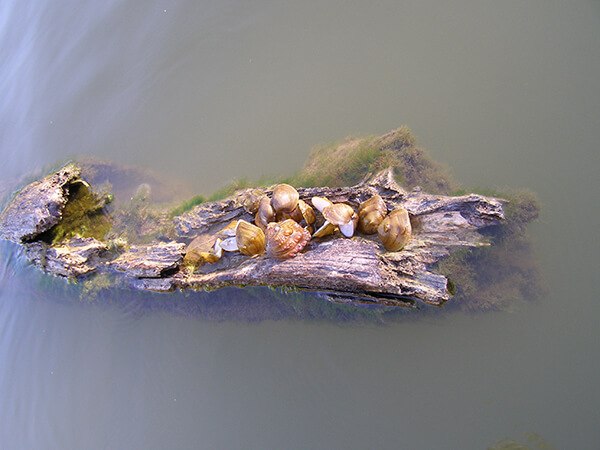
Mussel shell midden left behind by a hungry predator, likely a muskrat, on the East Fork White River in Martin County.
Mussels
- Can I use freshwater mussels as bait?
No. All native freshwater mussels are protected from take (harass, hunt, capture, or kill; or attempt to harass, hunt, capture, or kill) from the waters of the state.
- Can I keep freshwater mussel shells that I find?
No. All native freshwater mussels and their shells are protected from take (harass, hunt, capture, or kill; or attempt to harass, hunt, capture, or kill) from the waters of the state. To legally possess native freshwater mussel shells, an individual would need to obtain a scientific purposes license or a special purpose possession permit. Some non-native mollusk (Corbicula sp., Dreissena sp.) shells can be kept, but the animals must be killed immediately upon capture. Correct identification is critical before any mollusk species are killed. Learn more about non-native mussels.
Fish
- What do I do if I catch an endangered fish species while angling?
It should, as quickly as possible, be released unharmed back into the water from which it came. It is illegal for a person to take (harass, hunt, capture, or kill; or attempt to harass, hunt, capture, or kill), possess, transport, export, process, sell or offer for sale, or ship any Indiana endangered species. View Indiana’s current endangered fish species.
- I caught a fish, and I don’t know what it is – can I get help with identification?
Our fish identification page provides some helpful tips for identifying some of our more well-known sportfish in the state. If you can’t find the fish you caught on this page – feel free to email a photo with (1) the name of the water body where it was caught, (2) location of the catch (closest bridge, address, or other landmark), (3) date of catch, and (4) your name and phone number to fishid@dnr.IN.gov.
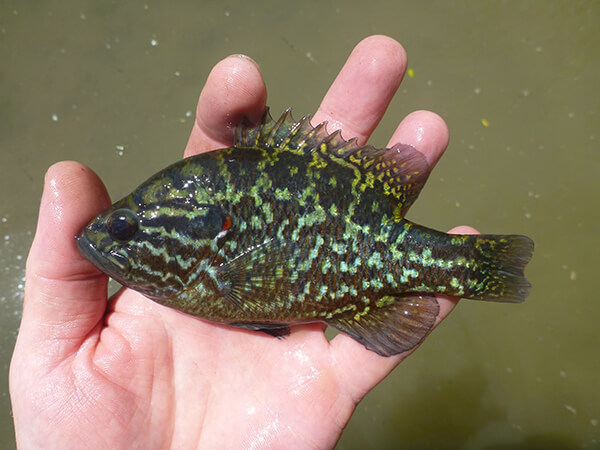
A warmouth.