How to Start Deer Hunting
White-tailed deer are a regulated species in Indiana and can be hunted across multiple different seasons.
- Youth Season
- Archery Season
- Firearms Season
- Muzzleloader Season
- Deer Reduction Zone Season
For details, view Deer Hunting Seasons.
Gear & Equipment
To hunt deer in Indiana, you must have a valid license unless you meet an exemption criterion in state law. While hunting on any land (public or private), you must carry a physical or digital license or license hard card displaying one of the following licenses:
- Deer Hunting License (Bundle, Archery, Firearms, Muzzleloader, Reduction Zone, Military/Refuge, or Multi-season Antlerless)
- Resident Youth Hunt/Trap License
- Lifetime Comprehensive Hunting License
- Lifetime Comprehensive Hunting and Fishing License
License
With most licenses, you can only take one deer per license. However, you can harvest more than one deer with a deer license bundle, lifetime comprehensive hunting license, lifetime comprehensive hunting and fishing license, or youth hunt/trap license. The total number of deer taken with these licenses or with all regular deer licenses (archery, muzzleloader, firearms, and multi-season antlerless) combined cannot exceed the state bag limit of 1 antlered deer and 6 antlerless deer or the county antlerless bag limit of the county being hunted. View deer hunting licenses.
Hunters can use any legal hunting equipment for deer as long as that deer hunting season is open and they have the appropriate license or meet a license exemption.
- For example, if you have a deer license bundle, you can carry both a bow and a rifle during firearms season because archery season is also open.
- You can carry more than one type of firearm when hunting during the firearms season, youth season, and in reduction zones (but only in areas where local laws permit the use of firearms).
- Additionally, hunters are allowed to use firearms with suppressors to hunt deer if they are also following federal regulations to possess a suppressor.
- View more information on deer hunting equipment regulations.
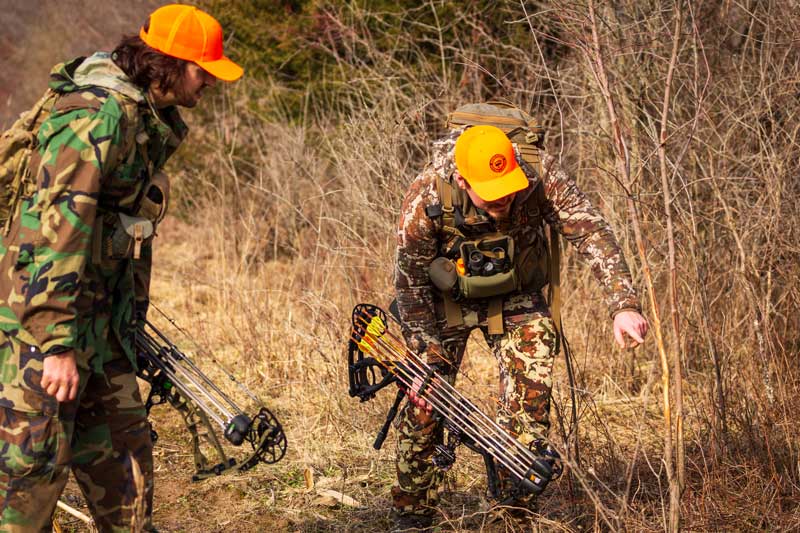
Hunter orange is required for all deer hunters during:
- Youth season
- Firearm season
- Muzzleloader season
- Archery season when it overlaps with firearms or muzzleloader season
- Deer Reduction Zone season on and after Nov. 15
Hunter orange must be always worn during the hunt, including walking to and from the hunting location.
A ground blind must have at least 144 square inches of hunter orange material that is visible from any direction during any season in which a hunter is required to wear hunter orange.
Wear a good pair of boots, clothes that are warm/breathable depending on the season, and earth tones. Bring a backpack with you for your supplies, such as deer calls, and a field dressing kit.
Scouting
While deer are widespread throughout Indiana, it’s best to pinpoint locations with adequate concentrations of food sources, cover, and water.
It’s easiest to spot deer when they are moving. You may see them chasing, foraging, or running away with their tail raised. Because their colors help them blend in with their surroundings, parts of them may be difficult to spot when they’re not moving.
There are other ways to identify when deer are around you:
- Vocalizations (grunts, snorts, wheezes)
- Silence of songbirds or a territorial blue jay call
- Movement in brush
Deer Signs
When animals move about a landscape, they frequently leave evidence that they were there, whether through prints, scat, or other traces.
Tracks: Deer leave tracks consisting of two 1-4-inch paired teardrop shapes with two circles sometimes behind the wider part of the teardrop.
Rubs: Bucks will leave rubs as they’re preparing for the rut. Rubs are smaller trees where the bark has been rubbed off by the buck as he removes velvet from his antlers.
During the Hunt
View the Where to Hunt Map for a list of hunting properties near you.
Hunting Tactics
- Taking an ethical shot means taking all factors surrounding safety into consideration when hunting. An ethical shot kills the deer quickly, allows for recovery of the animal, and doesn’t cause harm to other animals or people.
- Be extra careful when hunting near residential areas and do not shoot in their direction. Be sure of your target and what’s beyond it.
- Avoid shooting the deer if it is silhouetted on a ridgeline and you cannot see beyond it.
- Focus on safety anytime you are hunting or using firearms.
Still Hunting
- Still hunting refers to a style of hunting where you move slowly through an area while stopping frequently to look and listen. Hunters should spend more time stopping to look and listen than they should walking.
- If you spot a deer that’s outside your effective range, sit and wait or move in closer without detection. Earlier in the season, there is a higher chance that the deer will not be educated to human hunters and will not seek cover as you approach.
Sit and Wait
- Find an area where you know deer are active. Sit in a spot that gives you a good vantage point but is also in range of making an ethical shot. Wait until a deer is close enough to position your gun or draw your bow.
- You can also use a blind to conceal your presence when hunting this way.
Tree stands are a great way to get above deer to see them better and avoid their keen senses. You’ll want to set up a stand in a spot where you know deer are active and you have good sightlines to put the deer in range for an ethical shot.
It’s important to follow proper tree stand safety rules:
Before the Hunt
- Know your equipment.
- Read and understand manufacturer’s instructions and warnings before using your tree stand and full-body harness (FBH).
- Check stands and climbing aids (including straps and chains) every season and before each use for signs of wear, fatigue, cracks, and loose or missing nuts and bolts. Replace as necessary. It is recommended to remove stands after the season ends. (See Deer Regulations for laws regarding tree stands on public lands.)
- Practice at ground level with your tree stand and FBH with another person present.
- Learn how to properly use your FBH with a suspension release device.
- Find a healthy, straight tree that is the right size for your tree stand.
- Check the tree for insect nests and animal dens.
- Avoid using climbing stands on smooth-barked trees, especially during icy or wet conditions.
- Clear debris from the base of the tree to minimize injury from a fall and to ensure a safe base if using a ladder stand.
During the Hunt
- Wear an FBH. Simply owning an FBH does not make you safe. You must wear it.
- Make sure your FBH is attached to the tree as soon as you start to climb.
- For an additional level of safety, use a tree stand safety rope.
- In the case of ladder stands, attach the FBH before securing the platform to the tree or stepping onto it.
- When climbing a ladder, keep three points of contact with the ladder at all times. Both hands and a foot or both of your feet and one hand should be used to support your body weight when using a ladder.
- Always be sure to use a supplied tether between the base and seat portion of the stand to connect the two sections.
- When using a platform stand, climb higher than the stand and then step down onto the platform. Slowly put your weight onto your stand to be sure of your balance.
- Use boots with nonslip soles to avoid slipping, especially in wet weather.
In the Stand
- Properly adjust your FBH. Whether standing or sitting, keep the tether-line distance between you and the tree as short as possible with no slack in the tether while in a seated position. This will minimize the distance in the case of a fall.
- Use a haul line. Always raise and lower your firearm, bow, or other equipment with a haul line.
- Make sure firearms have the muzzle pointed down, are unloaded, with the action open, and with the safety on, before attaching a haul line near the trigger or trigger guard.
- Make sure broadheads are covered before raising or lowering a bow with a haul line.
- If you fall, stay calm. By planning ahead, you can avoid additional problems.
- Have emergency equipment, such as a knife, cellphone, flashlight, and/or whistle on your person.
- Practice the three Rs: recover, relief, and rescue. Attempt to recover and return to your stand. If this is not possible, exercise your legs by pushing against the tree, using another form of motion or your suspension relief device until help arrives.
- Use a hunt plan. Let someone know where you are hunting and when you will return.
You can use tree stands for hunting deer during all hunting seasons. However, it’s against the law to set up or hunt from a permanent tree stand on state-owned or state-leased land. You can use portable tree stands on DNR Property and in Hoosier National Forest
Where deer hunting is allowed, you can leave your portable tree stand in place overnight on DNR properties from noon on Sept. 15 to Jan. 10 and on DNR property within deer reductions zones from noon on Sept. 1 to Feb. 8. If you’re using any fasteners to attach the tree stand, they can’t go deeper than half an inch into the tree. You must also clearly mark your stand with your name, address, and phone number, or your DNR Customer ID number if it’s on public land.
After the Hunt
When you harvest a deer, you need to do the following to tag it properly:
- Immediately after you harvest the deer, write a temporary transportation tag on a piece of paper. This tag must include:
- Your name and address
- The sex of the deer (male or female)
- Your license number (if you have one)
- The date (month and day) you harvested the deer
- You don’t have to attach the tag to the deer while you’re moving it out of the field, but you must have the completed tag with you.
- Always keep the deer within eyesight until you’ve attached the completed temporary tag to it.
After harvesting a deer, you must check it in with the DNR within 48 hours. You can do this in one of three ways:
- Online: Visit GoOutdoorsIN.com or the GoOutdoorsIN app and select CheckIN Game
- By Phone: Call 260-368-5880 (no fee required)
- In Person: Visit a check station or a store that sells licenses, and they can help register the deer for you
After you check in the deer, you’ll get a confirmation number. Write this number down and keep it with the deer until it is processed.
Email INHuntFish@dnr.IN.gov or call 317-232-4200 if you need to correct a check-in. Include your name and confirmation number.
Remember that the deer’s head must stay attached to the body until you have checked in the deer and received your confirmation number.
Check-in is also required before the deer leaves the state.
Interested in skinning and processing your deer into delicious wild game cuts on your own? Visit our deer processing webpage for videos and instructional guides on how to skin, breakdown, and preserve your harvest this fall.
If you’re more interested in taking your deer to a commercial deer processor, then check out our webpage highlighting all DNR-registered commercial deer processors to find one near you!